Something I’ve been pondering today: What does it mean to live in the hope and the contentment of where God has placed me today?
I keep trying to ride the coattails of the past but they only take me back, back to what was instead of what is. I keep looking back to moments in the past but they make me forget that what was is no longer what is. I keep getting lost in glimpses of the past, but absence turns fondness of what was not rather than what is. I keeping wishing for the known of the past, but there can’t be a future in what was – only in what is and what will be.
Living is confusing, filled with anxiously wrestling the joy and grief of this twisted world where good and evil coincide and life and death are intertwined. But a little voice deep inside whispers that a better day will rise… but not yet.
Loving is bruising, battered by bitter hating, yet also longing for redemption. But truth seems stolen by a lie and kindness by selfish pride. Still a little voice deep inside whispers that a better day will rise… but not yet.
Hoping is exhausting, to cling to what is coming, but no one is looking for what’s to come. While everyone lives with a sigh it feels safer to cling to the night rather than trusting a promise, and hope that a better day will rise… but not yet.
Trust is the already but not yet – the almost grasping but cannot get. Keep going through the blood and sweat and never forget that we’ll see the promised day that we hoped for, but not yet.
A heart full of dreams but hands full of ashes – Life is too short and you don’t get second chances. Eyes bright with hope, while the heart is sad – Live in the good of today and do not betray the life you have, even though it’s not the life you wish you had.
What does it mean to trust God when we don’t understand our circumstances? This poem is a small piece of what I’ve been processing over the past couple of years.
I came to the fields to sow some seed, hoping for a harvest to succeed, but when I stood before the hardened ground no seeds and no harvest were to be found. I prayed to the God of the harvest that He would provide as He had promised, but as I looked upon barren lands no life and no strength was in my hands. Everything that I hoped for was gone and I cried, “My God, what have you done?” I heard no great thunder in response and no resolve to my circumstance. In agony my anxious heart prevailed; I tried to understand why good had failed. As I angrily and anxiously prayed, I heard a quiet voice in my soul say, “Will you wrestle in vain with your lot, or will you be still and know that I am God?
You are able To save us from the fire You are able To calm the violent storm So we ask you, Lord deliver us from trouble Let us see your goodness again But if by some myst’ry of your grace, We’re called to walk through flames, Our lips will still proclaim:
You are good, Though we can’t see past the darkness. You are good, When we’re lost within the sea. You are good, Though our hearts begin to fail us. You have not abandoned us, For you are good.
With a word, You can raise the dead to life And bring peace To a world consumed by war. So we ask you, Lord, deliver us from evil Let us see you reigning on earth Yet if by some mystery of your ways, You call us to remain, Our hearts will still proclaim:
You are good, Though we’re walking through the valley You are good, When we weep beside the tomb. You are good, Though our hearts try to condemn us. You have not forgotten us, For you are good.
As we walk, Remind us of your strength. As we grieve, Turn our hearts to hope in you. Oh, we ask you, Lord Give us hearts that trust your promise While our lives are torn by sin and death Help us wait with eyes fixed on the day when you return to reign, and forever we’ll proclaim:
You are good! You delivered us from evil. You are good! All your promises are true. You are good! Giving life to those who trust you. You have not forsaken us You are good!
When I read Psalm 4 recently, I didn’t expect to live in it for the next several days, but God continually encouraged and convicted me as I read. So I read and read again, more and more slowly, trying to soak in the soul treasure I found.
Here are some reflections on this Psalm and how it has been feeding my soul over the past couple of weeks.
1. Confounding Boldness
“Answer me when I call, O God of my righteousness… Be gracious and hear my prayer” (vs. 1).
When I read verse 1 of this Psalm, I couldn’t move beyond thinking about the boldness of these prayers. “Answer me,” “be gracious,” and “hear my prayer” are imperatives (the verb mood that communicates commands and forceful pleas).
In the modern cultural context of presumption and familiarity with the psalms, I forget to marvel at the boldness of speaking to God in this way. Pause and consider with me – it should be confounding, that anyone can talk to the holy, righteous, omnipotent God with this kind of expectancy.
What warrants such boldness? He is the “God of my righteousness” (vs. 1). God has revealed himself to his people and initiated relationship. He is the God who personally draws near, saves, justifies, and vindicates his people. Jesus Christ is the fulfillment of this steadfast love and salvation!
This is a God that we can boldly cry out to with expectancy!
2. God’s Compassionate Heart
“You have given me relief when I was in distress” (vs. 1).
Reading this, I am so grateful for the “when.”
There isn’t a checklist of what qualifies as worthy of being given relief from God. My God is so compassionate and caring that whenever I am in distress, and whatever distresses me as his child, it is his heart to give relief.
This statement is also sandwiched between cries to God.
God’s past faithfulness fuels David’s present confidence, and it should for me too.
When I look back at the many ways God has given me relief when I was in distress, I can’t help but be strengthened to trust God in my present distresses.
3. “How long” and “Know” Go Together
“O men, how long shall my honor be turned into shame? How long will you love vain words and seek after lies? But know that the LORD has set apart the goldy for himself; the LORD hears when I call to him” (vs. 2-3).
The exasperation of “how long” is followed by the confident “know” that God will not abandon those whom he has set his personal care and affection on.
Life is full of the groanings of “how long.” The reality of suffering, especially long suffering in this life is exhausting and confusing, but the answer doesn’t lie in the “why” of suffering; rather, the answer lies in what we know to be true about God. Those whom God has made his own through Jesus Christ can be boldly confident that he not only hears their groanings, but that he personally cares for them.
4. When (Not If) Anger Comes
“Be angry, and do not sin; ponder in your own hearts on your beds, and be silent. Offer right sacrifices, and put your trust in the LORD” (vs. 4-5)
Suffering often involves being wronged by someone; therefore, suffering often involves feeling anger.
When I am angry, my first impulse is to say and/or do something, because the emotion of anger, by its very nature, prompts physical action.
In this Psalm, God graciously instructs me to “ponder” instead of do and to “be silent” instead of giving vent to my anger. When I feel angry, I am called to turn to God in faith and trust, rather than churning in my anger.
I don’t know if you’re like me, but when I consider this instruction, I feel overwhelmed.
When I’m wronged, the anger I feel involves right anger, but it’s also deep and consuming. How do I obey God in the midst of the intense, right, mixed with wrong anger I feel?
By entrusting myself and my heart and my distress to the one who cares for me.
How long? I know my God hears and cares when I call to him.
5. He IS ourGood
“There are many who say, ‘Who will show us some good? Lift up the light of your face upon us, O LORD!” (vs. 6).
In a world filled with evil and confusion, may this reality shape my heart:
Not only has God shown me abundant goodness, he is my good.
He has lifted the light of his face in the person of Jesus Christ; God has given me himself.
The Light of salvation has come, and nothing will put it out!
6. Earthly Experiences vs. Spiritual Realities
“You have put more joy in my heart than they have when their grain and wine abound” (vs. 7).
As I read this verse, a quote from one of my pastors kept coming to mind:
“To have Christ is to have all that God can give you.” -Jeff Purswell
Those who know and trust the Lord have a joy that isn’t rooted in the abundance or lack of their circumstances.
Throughout our lives, circumstances constantly shift. They are confusing – those opposed to God prosper and those who seek to honor God suffer.
The bottom line: circumstances are a poor gauge of spiritual realities.
Real joy comes from eternal realities that don’t change because of earthly experiences.
If you are in Christ, God has set his personal attention and affection on you FOREVER. This is worth rejoicing in, even when life doesn’t make sense.
7. Where does real peace come from?
“In peace I will both lie down and sleep, for you alone, O Lord, make me dwell in safety” (vs. 8).
My anxious heart pushes back against this statement.
But bad things happen everyday.
But I did get hurt.
I don’t feel safe.
How could anyone feel safe in THIS kind of world?
Danger is around every corner, oozing from within and without.
How can I really experience peace in a dangerous world?
Peace doesn’t come from the absence of impending suffering. It comes from knowing that I am at peace with God (because of Jesus Christ) and that God is faithful to those whom he has “set apart.”
Faithful? When bad things happen?
Yes.
Physical danger and suffering doesn’t change this spiritual reality:
I can lie down and sleep, rather than be filled with anxious toil, because God is trustworthy. He does what he promises. He cares for me, protects me, and will preserve his own. Because of the finished work of Jesus Christ, I am eternally secure and safe.
This Christmas is a time of grief for my family. Multiple empty places where loved ones once filled, beautiful memories turned bittersweet, and perplexities that fill the silence. Earlier this month, as I was prayerfully attempting to come to terms with the death of a[nother] family member during the holidays, this thought kept coming to mind, “This is what Jesus came for.” He came that we would not grieve without home. In coming to take away the sins of the world, in coming to reconcile us to God, he gave us an eternal hope and comfort as we live in a world that constantly shoots us with the arrows of suffering.
Christmas isn’t a time only meant for jolly frivolity, it is a time when we proclaim the one who has “borne our griefs, and carried our sorrows” (Isaiah 53:4). This poem was inspired by these thoughts and by the Christmas sermons over the past few weeks in which my pastors faithfully reminded us that Christ’s coming isn’t just generally good news, but personally life transforming news.
So if (like me) you’re feeling a little out of place in holiday celebrations because you’ve been living in the trenches of suffering, this poem was written for you.
For Unto You
Joyous cries of delight have become crimson eyes. Christmas cheer is melted by painful last goodbyes.
While singing fills the air, you see that empty chair, empty bed, empty heart – a loving warmth stripped bare.
When your joy becomes tears, when hopes turn into fears, and it feels like Christmas is for those who believe in fairytales, Remember that unto you, unto you a Savior was born who will wipe away your tears.
Lights and celebrations – not when your world is shaken. No more merry and bright, No cheer on this dark night.
The magic of Christmas that twinkled in our eyes grows dark with each new year as those we dearly love are no longer here.
Sad hearts can learn to sing and painful ashes bring without fear at Christmastime. For Christ came to them, To those in suffering.
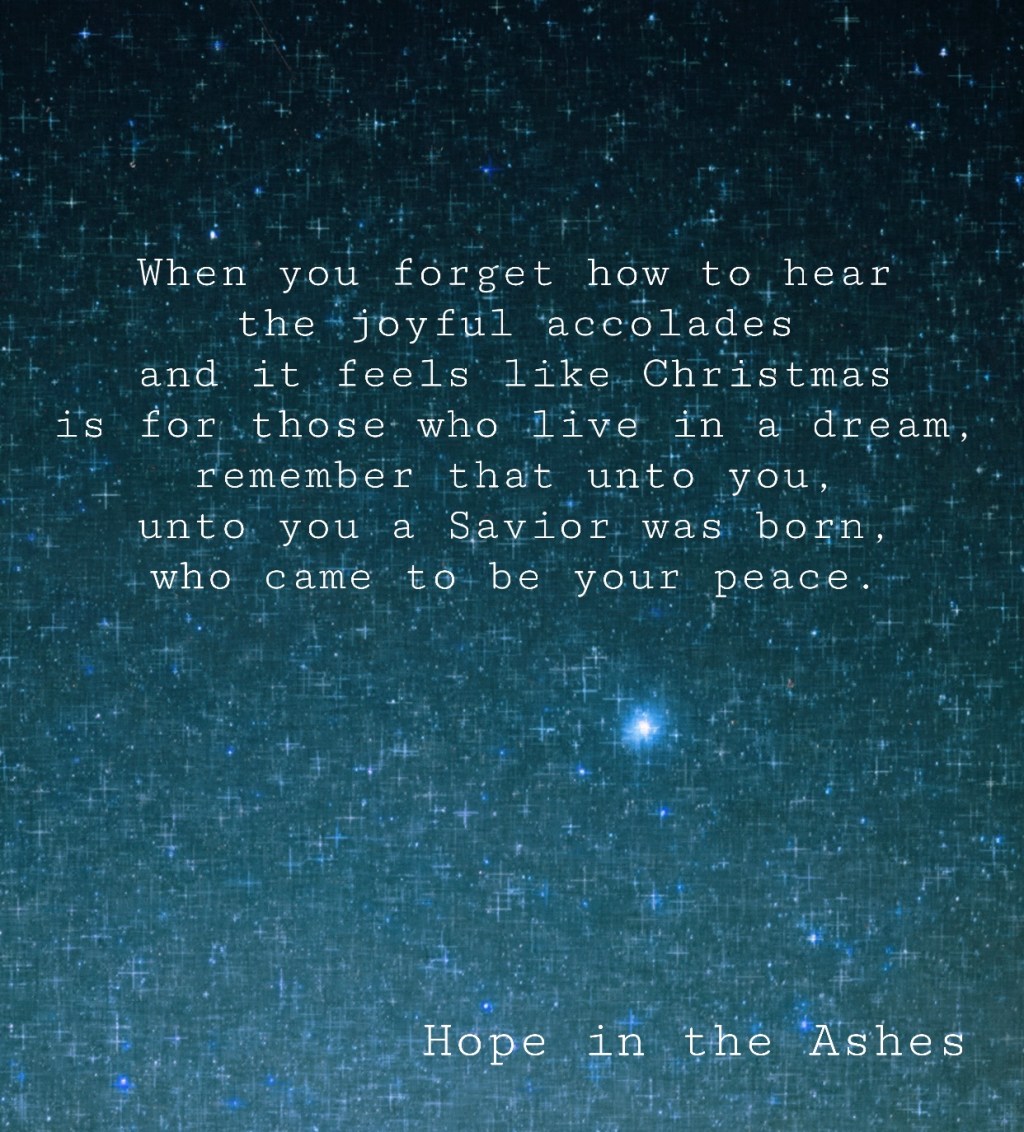
When you forget how to hear the joyful accolades and it feels like Christmas is for those who live in a dream, remember that unto you, unto you a Savior was born, who came to be your peace.